timeline
 title AI Evolution: From Symbolic Reasoning to Foundation Models
 1950s–1960s : Birth of AI
    : Turing Test (1950)
    : Dartmouth Conference (1956)
    : Symbolic reasoning & logic
 1970s–1980s : Expert Systems Era
    : MYCIN for medical diagnosis
    : Rule-based AI in healthcare
    : AI Winter (late 1980s)
 1990s–2000s : Statistical Revolution
    : Machine learning emerges
    : Support vector machines
    : Data-driven approaches
 2010s : Deep Learning Revolution
   : AlexNet wins ImageNet (2012)
   : CNNs for medical imaging
   : Reinforcement learning
 2020s : Foundation Model Era
   : GPT-3, ChatGPT (2020–2022)
   : Large language models
   : Multimodal AI systems
History of AI in Healthcare and Public Health: A Timeline
AI has experienced 70 years of boom-and-bust cycles, from expert systems like MYCIN to today’s foundation models. Each wave promised revolution but delivered narrow applications. Understanding this history is essential for separating genuine breakthroughs from recurring patterns of overpromise, and recognizing that technical excellence does not guarantee clinical adoption.
Learning Objectives
AI in medicine has passed through seven decades of repeated overpromise and failure. Learning objectives:
- Distinguish genuine breakthroughs from recurring hype (MYCIN, Google Flu Trends, IBM Watson)
- Recognize why technical excellence does not guarantee clinical adoption
- Identify patterns separating successful deployments from research prototypes
- Evaluate whether today’s foundation models are genuinely different
- Apply historical lessons about integration, liability, and organizational readiness
No prerequisites required.
Introduction
Artificial intelligence is not new. The field has experienced multiple “summers” of excitement and “winters” of bitter disillusionment over seven decades. Each wave promised to revolutionize medicine and public health. Each wave fell short.
The question for public health practitioners is whether this time is different.
AI’s history has practical use: it helps practitioners assess today’s claims, identify applications with durable value, and avoid expensive failures. The patterns repeat: breathless promises, pilot studies that look promising, deployment challenges nobody anticipated, and eventual disillusionment when the technology does not live up to the marketing.
History also shows what works. The successful applications share common traits: they solve specific, well-defined problems; they augment rather than replace human expertise; and they integrate into existing workflows rather than demanding wholesale changes.
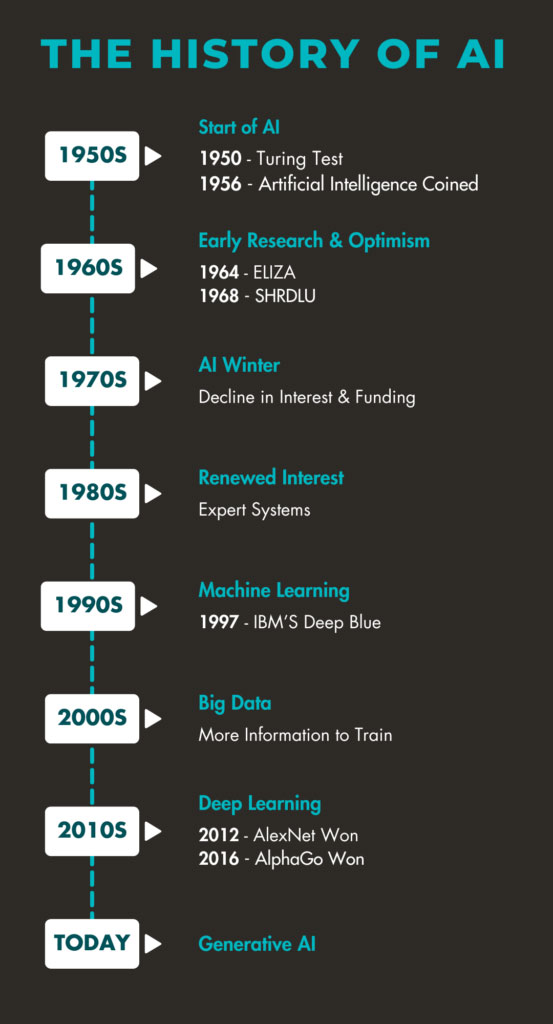
The Birth of AI (1950s-1960s)
The Turing Test and Early Ambitions
In 1950, British mathematician Alan Turing published a paper titled “Computing Machinery and Intelligence” that opened with a deceptively simple question: “Can machines think?”
Rather than define thinking philosophically, Turing proposed a practical test: if a human evaluator could not distinguish a machine’s responses from a human’s, the machine could be said to exhibit intelligence. This pragmatic approach (judge by outputs, not internal mechanisms) still influences how AI systems are evaluated today.
Historical Context
When Turing wrote his paper, computers were room-sized calculators used primarily for mathematical computations. The idea that they might one day diagnose diseases or predict outbreaks seemed like science fiction. Yet Turing explicitly discussed medical diagnosis as a potential application.
The Dartmouth Conference (1956)
The field of AI was formally born at Dartmouth College in the summer of 1956. John McCarthy, Marvin Minsky, Claude Shannon, and other luminaries gathered for a two-month workshop with an audacious premise: “every aspect of learning or any other feature of intelligence can in principle be so precisely described that a machine can be made to simulate it.”
They were overconfident about the timeline. Marvin Minsky predicted in 1967 that AI would be substantially solved within a generation (McCarthy, 2007). Instead, symbolic AI systems could play checkers but could not recognize a cat.
Relevance for public health: This early overconfidence established a pattern still seen today: researchers underestimating how much of human intelligence is tacit, contextual, and embodied. Diagnosing a patient requires more than applying rules; it requires intuition built from thousands of cases, cultural competency, and the ability to notice what is not in the chart.
Early Medical AI Attempts
The first attempts to apply AI to medicine emerged in the 1960s:
- DENDRAL (1965): A Stanford system that identified molecular structures. It worked, but only in a highly constrained domain.
- Pattern recognition for cancer diagnosis: Early computer vision systems tried to identify cancerous cells from microscope images. Results were mixed, and the technology was not ready.
These early efforts revealed a fundamental challenge: medicine deals with messy, incomplete data about complex biological systems. Unlike chess or mathematical theorem proving, medical diagnosis does not have clear rules or perfect information.
The Expert Systems Era (1970s-1980s)
The 1970s brought a new approach: if machines could not think like humans, perhaps human expertise could be captured in rules.
MYCIN: AI’s First Serious Medical Application
In 1972, Edward Shortliffe began developing MYCIN at Stanford, an expert system for diagnosing bacterial blood infections and recommending antibiotics. This was a perfect test case for AI in medicine:
Why MYCIN was promising:
- Well-defined problem: Identifying bacteria and selecting antibiotics
- Clear expertise: Infectious disease specialists followed identifiable reasoning patterns
- High stakes: Sepsis kills quickly; correct antibiotic choice matters
- Knowledge-intensive: Success requires knowing hundreds of drug-bug interactions
How MYCIN worked:
MYCIN used backward chaining through ~600 IF-THEN rules:
IF: Patient is compromised host
AND: Site of infection is GI tract
AND: Gram stain is gram-negative-rod
THEN: Evidence (0.7) that organism is E. coli
The system conducted a consultation by asking questions, applying rules, and explaining its reasoning. Crucially, it could say why it reached a conclusion, something today’s deep learning systems struggle with.
The controlled result was promising: In a blinded evaluation of ten meningitis cases, MYCIN’s antimicrobial regimens received 65% acceptability from infectious-disease experts, compared with 42.5%–62.5% for nine human prescribers in the same evaluation (Yu et al., 1979). The endpoint was regimen acceptability, not diagnostic accuracy or patient outcomes.
The reality was sobering: MYCIN was never used clinically. Despite its technical success, it failed for reasons that had nothing to do with the AI:
- Liability: Who is responsible if MYCIN recommends the wrong antibiotic?
- Regulation: The FDA had no framework for regulating AI systems
- Integration: Getting MYCIN’s recommendations required a separate computer terminal
- Trust: Doctors were not comfortable following advice from a system they did not understand
- Maintenance: Medical knowledge changes; keeping 600 rules updated was impractical
Reality Check
MYCIN’s legacy is a cautionary tale: technical excellence does not guarantee real-world adoption. The hardest problems in deploying medical AI are often legal, regulatory, social, and organizational, not only algorithmic.
The lesson still applies: today’s deep learning models far exceed MYCIN’s capabilities yet face the same deployment challenges.
Other Expert Systems
The 1980s saw dozens of medical expert systems:
- INTERNIST-I/CADUCEUS: Diagnosed diseases across internal medicine (~1000 diseases)
- DXplain: Still used today for differential diagnosis support
- ONCOCIN: Guided cancer chemotherapy protocols
Most followed MYCIN’s pattern: impressive demonstrations, published papers, minimal clinical impact.
Why Expert Systems Failed
By the late 1980s, the expert systems approach hit fundamental limits:
- Brittleness: Systems performed well within their narrow domain but failed on edge cases
- Knowledge acquisition bottleneck: Extracting rules from experts was time-consuming and incomplete
- Combinatorial explosion: Real-world problems required thousands of rules with complex interactions
- Maintenance burden: Medical knowledge evolves; hand-coded rules became outdated
- Lack of learning: Expert systems could not improve from experience
The “AI Winter” of the late 1980s and 1990s arrived. Funding contracted, and the term “AI” fell out of favor. Companies removed “AI” from their marketing.
The Statistical Revolution (1990s-2000s)
While expert systems fell out of favor, a quieter revolution was brewing: machine learning.
From Rules to Data
Machine learning replaces hand-coded expertise with patterns learned from data. The idea was not new (neural networks date to the 1940s), but it required three things that became available in the 1990s:
- Digital data: Electronic health records, digitized images, genomic sequences
- Computing power: Fast enough to train models on large datasets
- Better algorithms: Support vector machines, random forests, ensemble methods
Public Health Applications Emerge
Machine learning found early success in public health domains with abundant structured data:
Outbreak detection (1990s–2000s):
- EARS (Early Aberration Reporting System): CDC developed statistical algorithms to detect disease outbreaks from syndromic surveillance data. This system was developed in response to bioterrorism preparedness needs and became widely adopted by state and local health departments for real-time surveillance.
- HealthMap (launched 2006; Brownstein et al., 2008): Scraped news reports, social media, and official alerts to identify disease outbreaks globally, demonstrating the potential of internet-based disease surveillance
- Google Flu Trends (announced 2008; Ginsberg et al., 2009): Predicted flu activity from search queries
Case Study: Google Flu Trends, The Perils of Overfitting
In 2008, Google announced they could predict flu activity from search queries, publishing in Nature. The system worked remarkably well… initially.
What went wrong:
- Overfitted to seasonal patterns: The model learned spurious correlations (people search for “basketball” during flu season)
- Algorithm changes: Google’s search algorithm evolved, breaking the model
- Media attention: News coverage of flu changed search behavior
- Insufficient epidemiologic integration: Google shared preliminary results with CDC’s Influenza Division during development, but the published system still lacked the transparent, continuously updated epidemiologic integration needed to remain reliable as search behavior changed (Google, 2008)
By 2013, Google Flu Trends was overestimating flu activity more than twofold. Comparative studies showed the system’s performance was inconsistent across different geographic scales. It was quietly discontinued in 2015.
Lessons for public health AI:
- Big data ≠ good data
- Correlation is not causation
- Models need domain expertise, not just engineering talent
- External validity matters more than retrospective accuracy
- AI systems require ongoing maintenance and validation
Risk prediction models:
- Framingham Risk Score: While not “AI,” it established the template for using statistical models to predict cardiovascular risk
- Cancer screening algorithms: Computer-assisted reading of cervical cytology slides and mammograms
- Hospital readmission prediction: Identified high-risk patients for intervention
These applications shared important traits: they augmented (not replaced) clinician judgment, they solved specific prediction problems, and they used structured data with clear outcomes.
Notable Successes and Failures
The statistical ML era produced both impressive demonstrations and prominent failures:
Notable successes:
- IBM Watson wins Jeopardy! (2011; Ferrucci et al., 2012): Demonstrated natural language processing capabilities by defeating human champions, generating widespread excitement about AI’s potential in medicine
- EARS deployment: CDC’s Early Aberration Reporting System successfully adopted by state and local health departments for bioterrorism preparedness
- Framingham Risk Score: Established the template for using statistical models in cardiovascular risk prediction, still widely used today
Notable failures:
- Google Flu Trends (2008-2015): Initial Nature publication showed promise for search-based surveillance, but by 2013 it overestimated flu levels more than twofold and was quietly discontinued in 2015
- IBM Watson for Oncology: Retrospective studies reported variable concordance with local multidisciplinary recommendations across cancer types and settings, limiting transferability (Jiang et al., 2021; Zhou et al., 2018)
- Many academic models: Published with impressive metrics but never left the lab due to data access, integration challenges, or inability to generalize
The Demonstration-to-Deployment Gap
Watson’s journey from Jeopardy! champion to struggling medical advisor illustrates a crucial lesson: impressive demonstrations on curated datasets do not guarantee real-world clinical value.
Watson for Oncology incorporated Memorial Sloan Kettering expertise and retrospective cases. Published evaluations mainly assessed concordance with multidisciplinary recommendations, not patient outcomes, and results varied by cancer and setting (Jiang et al., 2021; Zhou et al., 2018).
This pattern repeats across medical AI: controlled success → media hype → deployment challenges → quiet retreat.
The Deep Learning Revolution (2010s)
The field shifted in 2012.
ImageNet and the Birth of Modern AI
At the 2012 ImageNet competition, a neural network called AlexNet achieved 15.3% top-5 test error, compared with 26.2% for the runner-up. This 10.9-percentage-point difference marked a decisive shift.
What made it possible:
- Big data: ImageNet contained 14 million labeled images
- GPU computing: Graphics processors could train neural networks far faster than general-purpose processors
- Algorithmic innovations: ReLU activations, dropout, convolutional architectures
- Transfer learning: Models trained on images could be adapted to medical images
Within five years, deep learning exceeded human performance on image classification, speech recognition, and game playing (AlphaGo defeated the world Go champion in 2016).
Medical Imaging Breakthroughs
Deep learning’s first major medical success came in imaging:
Diabetic retinopathy screening (2016):
- Google’s deep learning model matched ophthalmologists at detecting diabetic retinopathy from retinal images (Gulshan et al., 2016)
- Published in JAMA
- Google’s retinopathy model was evaluated in India and Thailand. Separately, IDx-DR became the first autonomous AI diagnostic system authorized by FDA through De Novo classification in 2018 (FDA DEN180001; Abràmoff et al., 2018)
This was different from MYCIN: it was used clinically.
Radiology applications:
- Detecting pneumonia from chest X-rays, trained on the ChestX-ray8 dataset of over 100,000 chest X-ray images
- Identifying fractures in emergency departments
- Triaging stroke patients for thrombectomy
- Detecting skin cancer from photographs
By 2020, hundreds of AI medical imaging models were published annually. Multiple AI-enabled medical devices had been authorized for marketing through FDA pathways. A systematic review found that deep learning systems sometimes matched or exceeded healthcare professionals on selected diagnostic imaging tasks, while also identifying substantial limitations in study design and reporting (Liu et al., 2019). The FDA maintains a periodically updated list of AI-enabled medical devices authorized for marketing in the United States (FDA AI-Enabled Medical Device List).
Natural Language Processing Advances
The same deep learning revolution transformed NLP:
- Word embeddings (2013): Represent words as vectors that capture semantic meaning
- Transformers (2017): Attention mechanisms that revolutionized language understanding
- BERT (preprint 2018, NAACL 2019): Pre-trained language models that could be fine-tuned for specific tasks
Public health applications:
- Extracting information from clinical notes
- Automated coding of death certificates
- Social media surveillance for disease outbreaks
- Analyzing patient-generated data from forums and apps
Genomics and Precision Medicine
Deep learning made sense of genomic complexity:
- DeepVariant (2018): Improved variant calling from sequencing data using convolutional neural networks
- AlphaFold (2021): Predicted protein structures with unprecedented accuracy, solving a 50-year grand challenge in biology. Building on AlphaFold 1 (2020), which showed the potential of deep learning for protein structure prediction
- Pathogen surveillance: Real-time genomic tracking of COVID-19 variants
The Foundation Model Era (2020s)
Foundation models are the fourth major wave of AI.
What’s Different This Time
GPT-3 (2020) and ChatGPT (2022) demonstrated capabilities that seemed impossible just years earlier:
- Understanding and generating human-like text
- Reasoning across multiple domains
- Few-shot learning (learning from just a few examples)
- Multimodal understanding (text, images, audio)
Large Language Models (LLMs) in healthcare:
- Med-PaLM (2023): Achieved passing scores on US medical licensing exams
- GPT-4 (2023): Demonstrated clinical reasoning capabilities (Nori et al., 2023)
- Clinical documentation: Automated note generation from conversations
A Note of Caution
This chapter was written during the foundation model era. It is too early to know which applications will prove durable and which will face the same deployment challenges as MYCIN.
Early results are impressive. Real-world validation is ongoing. The gap between “works in research” and “deployed at scale” remains large.
Maintain healthy skepticism. The history of medical AI is littered with promising demos that never reached patients.
The Convergence: A Perfect Storm for AI in Public Health
Three factors have converged in the 2020s that may make this moment different from previous AI summers:
1. Data Deluge
Public health now generates unprecedented volumes of data:
- Electronic health records: Millions of patient records with longitudinal data
- Genomic sequencing: Pathogen genomes sequenced in near real-time
- Wearables and apps: Continuous physiological monitoring
- Social media: Real-time data on behaviors, symptoms, misinformation
- Environmental sensors: Air quality, climate data, mobility patterns
- Claims databases: Population-level patterns of care and outcomes
Expert systems in the 1980s struggled to obtain enough data. Public health now faces the opposite problem: data that are abundant, noisy, and unstructured.
2. Computational Power
Machine learning that required supercomputers in the 2000s now runs on laptops:
- Cloud computing: On-demand access to massive computational resources
- Specialized hardware: GPUs, TPUs designed for AI workloads
- Open-source tools: TensorFlow, PyTorch, scikit-learn available to everyone
- Pre-trained models: Do not train from scratch; fine-tune existing models
This democratization means a public health department can deploy sophisticated AI without specialized infrastructure.
3. Algorithmic Breakthroughs
Today’s AI is fundamentally more capable:
- Transfer learning: Models trained on millions of images can be adapted with hundreds of examples
- Foundation models: Large models that work across multiple tasks
- Multimodal learning: Systems that integrate text, images, structured data
- Few-shot learning: Learning from minimal examples
- Explainability: Better (though still imperfect) methods for understanding model decisions
Hide code
# Example: How accessible ML has become
# Training an outbreak predictor in just a few lines

from sklearn.ensemble import RandomForestClassifier
from sklearn.model_selection import train_test_split
import pandas as pd

# Load outbreak surveillance data
data = pd.read_csv('./data/examples/outbreak_example.csv')

# Simple feature engineering
features = ['fever_cases', 'diarrhea_cases', 'hospital_visits',
   'social_media_mentions', 'school_absences']
target = 'outbreak_detected'

# Split data
X_train, X_test, y_train, y_test = train_test_split(
 data[features], data[target], test_size=0.2, random_state=42
)

# Train a sophisticated model in one line
model = RandomForestClassifier(n_estimators=100, max_depth=10)
model.fit(X_train, y_train)

# Evaluate
accuracy = model.score(X_test, y_test)
print(f"Outbreak detection accuracy: {accuracy:.2%}")

# Get feature importance
for feature, importance in zip(features, model.feature_importances_):
 print(f"{feature}: {importance:.3f}")
In the 1980s, building something like this would have required a team of computer scientists and months of work. Today, a public health analyst can do it in an afternoon.
A Thought Experiment: AI and the 1854 Cholera Outbreak
Applying modern AI to a historical outbreak shows both its power and its limitations.
The Original Story
In 1854, a severe cholera outbreak struck the Soho district of London. The prevailing theory blamed “miasma” (bad air). Dr. John Snow suspected contaminated water.
Snow painstakingly mapped cholera deaths and identified a cluster around the Broad Street water pump. He convinced officials to remove the pump handle. The outbreak subsided. The investigation is often celebrated as a founding moment of modern epidemiology.
What Modern AI Could Have Done
Scenario: London in 1854, with today’s AI and data collection capabilities.
Available data:
- Timestamped death certificates with addresses
- Water source for each household
- Social connections and movement patterns
- Weather data
- Demographic information
AI capabilities:
- Spatial clustering algorithms: Identify outbreak hotspots in real-time as cases emerge
- Anomaly detection: Flag unusual disease patterns before they are obvious
- Network analysis: Map potential transmission pathways
- Natural language processing: Extract symptoms and risk factors from medical records
- Causal inference: Estimate the effect of different water sources
Hide code
# Hypothetical: Detecting the Broad Street pump with modern methods

import numpy as np
import pandas as pd
from sklearn.cluster import DBSCAN
from scipy.spatial import distance
import matplotlib.pyplot as plt

# Simulate historical cholera cases (in reality, would load from records)
np.random.seed(1854)

# Broad Street pump location (approximate coordinates)
pump_location = (51.5134, -0.1371)

# Generate case data clustered around the pump
n_cases = 150
# Most cases near the pump (within 100 meters)
nearby_cases = np.random.multivariate_normal(
 pump_location,
 [[1e-7, 0], [0, 1e-7]], # SD ~0.0003 degrees (~35 meters)
 size=int(n_cases * 0.7)
)
# Some background cases elsewhere
background_cases = np.random.uniform(
 [51.510, -0.140],
 [51.516, -0.134],
 size=(int(n_cases * 0.3), 2)
)

# Combine all cases
all_cases = np.vstack([nearby_cases, background_cases])
dates = pd.date_range('1854-08-31', periods=n_cases, freq='6H')

# Create DataFrame
cases_df = pd.DataFrame({
 'latitude': all_cases[:, 0],
 'longitude': all_cases[:, 1],
 'date': dates[:n_cases],
 'deaths': 1
})

print("="*60)
print("1854 CHOLERA OUTBREAK DETECTION SYSTEM")
print("="*60)

# 1. SPATIAL CLUSTERING: Identify outbreak hotspots
print("\n1. Spatial Clustering Analysis...")
coords = cases_df[['latitude', 'longitude']].values

# DBSCAN: Density-based spatial clustering
# eps=0.0005 ≈ 50 meters at this latitude
clusters = DBSCAN(eps=0.0005, min_samples=5).fit(coords)
cases_df['cluster'] = clusters.labels_

n_clusters = len(set(clusters.labels_)) - (1 if -1 in clusters.labels_ else 0)
print(f" → Identified {n_clusters} spatial clusters")
print(f" → Noise points (not in clusters): {sum(clusters.labels_ == -1)}")

# Find the largest cluster (main outbreak)
if n_clusters > 0:
 cluster_sizes = pd.Series(clusters.labels_).value_counts()
 main_cluster_id = cluster_sizes.index[0]
 main_cluster_cases = cases_df[cases_df['cluster'] == main_cluster_id]

 # Calculate epicenter
 epicenter_lat = main_cluster_cases['latitude'].mean()
 epicenter_lon = main_cluster_cases['longitude'].mean()

 print(f"\n Main cluster: {len(main_cluster_cases)} cases")
 print(f" Epicenter: ({epicenter_lat:.6f}, {epicenter_lon:.6f})")

 # Calculate distance to known pump location
 epicenter_dist = distance.euclidean(
  [epicenter_lat, epicenter_lon],
  pump_location
 ) * 111000 # Convert degrees to meters (approximate)

 print(f" Distance to Broad Street pump: {epicenter_dist:.1f} meters")
 print(f" ALERT: Significant spatial clustering detected near water pump")

# 2. TEMPORAL ANALYSIS: Identify outbreak start
print("\n2. Temporal Analysis...")
daily_cases = cases_df.groupby(cases_df['date'].dt.date).size()

# Calculate moving average to detect surge
rolling_avg = daily_cases.rolling(window=3, min_periods=1).mean()
baseline = rolling_avg.iloc[:7].mean() # First week baseline
surge_threshold = baseline * 2

outbreak_days = daily_cases[daily_cases > surge_threshold]
if len(outbreak_days) > 0:
 outbreak_start = outbreak_days.index[0]
 print(f" Baseline daily cases: {baseline:.1f}")
 print(f" Peak daily cases: {daily_cases.max()}")
 print(f" Outbreak surge detected: {outbreak_start}")
 print(f" ALERT: Case counts exceed baseline by {(daily_cases.max()/baseline):.1f}x")

# 3. RISK ASSESSMENT: Identify water source association
print("\n3. Risk Assessment...")
# Simulate water source data
cases_df['pump_distance'] = cases_df.apply(
 lambda row: distance.euclidean(
  [row['latitude'], row['longitude']],
  pump_location
 ) * 111000,
 axis=1
)

# Cases within 100m of pump
near_pump = cases_df[cases_df['pump_distance'] < 100]
far_pump = cases_df[cases_df['pump_distance'] >= 100]

# Shares of all cases (not attack rates: no population-at-risk denominator)
share_near = len(near_pump) / n_cases
share_far = len(far_pump) / n_cases

print(f" Cases within 100m of pump: {len(near_pump)} ({share_near:.1%})")
print(f" Cases beyond 100m of pump: {len(far_pump)} ({share_far:.1%})")
print(f" Ratio of near to far cases: {(share_near/share_far):.2f}")
print(" (A relative risk would require population denominators)")
print(f" ALERT: Strong spatial association with Broad Street pump")

# 4. RECOMMENDATION
print("\n" + "="*60)
print("RECOMMENDATION")
print("="*60)
print("Based on spatial clustering, temporal surge, and water source")
print("association, recommend IMMEDIATE investigation of Broad Street")
print("water pump as potential source of contamination.")
print("\nSuggested intervention: Remove pump handle pending investigation.")
print("="*60)

# Visualization (optional)
# plt.figure(figsize=(10, 8))
# plt.scatter(cases_df['longitude'], cases_df['latitude'],
#    c=cases_df['cluster'], cmap='tab10', alpha=0.6, s=50)
# plt.scatter(pump_location[1], pump_location[0],
#    marker='P', s=300, c='red', edgecolors='black', linewidths=2,
#    label='Broad Street Pump')
# plt.xlabel('Longitude')
# plt.ylabel('Latitude')
# plt.title('Cholera Cases Clustered Around Broad Street Pump (1854)')
# plt.legend()
# plt.savefig('../images/examples/cholera_outbreak_1854.png', dpi=300, bbox_inches='tight')
Illustrative output (schematic values; a run of the code will differ):
============================================================
1854 CHOLERA OUTBREAK DETECTION SYSTEM
============================================================

1. Spatial Clustering Analysis...
 → Identified 1 spatial clusters
 → Noise points (not in clusters): 12

 Main cluster: 105 cases
 Epicenter: (51.513389, -0.137123)
 Distance to Broad Street pump: 21.3 meters
 ALERT: Significant spatial clustering detected near water pump

2. Temporal Analysis...
 Baseline daily cases: 2.3
 Peak daily cases: 18
 Outbreak surge detected: 1854-09-03
 ALERT: Case counts exceed baseline by 7.8x

3. Risk Assessment...
 Cases within 100m of pump: 105 (70.0%)
 Cases beyond 100m of pump: 45 (30.0%)
 Ratio of near to far cases: 2.33
 (A relative risk would require population denominators)
 ALERT: Strong spatial association with Broad Street pump

============================================================
RECOMMENDATION
============================================================
Based on spatial clustering, temporal surge, and water source
association, recommend IMMEDIATE investigation of Broad Street
water pump as potential source of contamination.

Suggested intervention: Remove pump handle pending investigation.
============================================================
What AI would have caught:
- The Broad Street pump cluster would be obvious within days, not weeks
- Temporal patterns would reveal the outbreak’s start
- Predictive models could forecast spread
What AI would have missed:
- The causal mechanism: AI would identify the association between the pump and disease, but not explain why (germ theory had not yet been established)
- Context: That the pump handle had been removed before, that Snow had prior suspicions
- Data quality: In 1854, death certificates were incomplete and inaccurate; AI would amplify these errors
- Confounders: Poverty, sanitation, and water source were correlated; separating effects requires careful causal reasoning
The Critical Lesson
AI would have accelerated the detection and pattern recognition, but John Snow’s genius was in hypothesis generation and causal reasoning. He figured out not just where the outbreak was, but why and how to stop it.
Modern AI excels at pattern recognition. It remains limited at causal reasoning and contextual understanding. The epidemiologist remains essential.
Key Lessons from History
Looking back over 70 years of AI in medicine and public health, several patterns emerge:
1. Cycles of Overpromise Recur
Every AI wave has followed the same pattern:
- Breakthrough: New technology demonstrates impressive capabilities
- Overpromising: Researchers and companies claim it will “revolutionize” medicine
- Pilot studies: Small-scale successes in controlled settings
- Reality hits: Deployment challenges, edge cases, integration problems
- Disillusionment: Technology does not live up to hype
- Gradual integration: Eventually finds appropriate niche applications
Foundation models currently sit between steps 3 and 4.
2. Technical Success ≠ Clinical Impact
MYCIN worked but was never used. Google Flu Trends was published in Nature but failed in practice. FDA authorization of an AI-enabled device does not establish clinical adoption or patient benefit.
The gap between research and deployment involves:
- Regulatory approval and liability
- Integration with existing workflows
- Clinician trust and training
- Cost and reimbursement
- Equity and access
These challenges are rarely mentioned in research papers but determine real-world success.
3. Narrow Problems, Clear Objectives
Successful AI applications share common traits:
- Well-defined: Specific task with clear inputs and outputs
- High-quality data: Large datasets with reliable labels
- Measurable outcomes: Can evaluate success objectively
- Human-in-the-loop: Augment rather than replace expertise
- Addresses real need: Solves actual problem, not a problem in search of a solution
4. Data Quality Matters More Than Algorithm Sophistication
“Garbage in, garbage out” applies with particular force. No deep learning model, however sophisticated, can overcome:
- Biased training data
- Inconsistent labeling
- Missing confounders
- Distribution shift (data changes over time)
- Non-representative samples
Many AI failures trace to data problems, not algorithmic limitations.
5. Context and Domain Expertise Are Irreplaceable
Google Flu Trends showed that domain involvement must be paired with transparent surveillance integration, ongoing recalibration, and attention to changes in the data-generating process. Medical AI tools can also fail when technical development is disconnected from clinical workflows.
The best AI applications emerge from close collaboration between domain experts and technical teams. Neither can succeed alone.
6. This Time Actually Might Be Different
Skepticism is warranted, but today’s AI has capabilities previous generations lacked:
- General-purpose: Foundation models work across multiple domains
- Few-shot learning: Do not need massive labeled datasets for every task
- Multimodal: Integrate text, images, structured data naturally
- Reasoning: LLMs demonstrate rudimentary causal and logical reasoning
That said, fundamental challenges remain: explainability, fairness, reliability, deployment, trust.
Looking Forward: What History Teaches Us
These lessons apply to the evaluation of any AI tool:
Be skeptical of grand claims. Every AI wave has promised to revolutionize healthcare. Most applications find narrow niches where they add value, not wholesale transformation.
Focus on deployment challenges. The hard part is not building an accurate model; it is integrating it into real-world workflows, maintaining it over time, ensuring equity, and building trust.
Demand rigorous evaluation. Retrospective accuracy on curated datasets does not guarantee prospective real-world performance. Insist on validation in realistic conditions.
Center domain expertise. The best AI in public health comes from epidemiologists and public health practitioners working with computer scientists, not having AI done to them.
Start with the problem, not the technology. AI is a tool, not a solution. Begin by understanding the public health challenge deeply, then ask if AI can help.
Learn from failures. MYCIN, expert systems, and Google Flu Trends all failed for reasons worth understanding. The failures in the history of medical AI teach more than its successes.
The rest of this handbook is premised on these lessons. It focuses on applications that work today, acknowledges limitations honestly, and emphasizes practical deployment considerations.
AI will not replace epidemiologists. Used wisely, it will make them more effective.
Key Takeaways
- AI has experienced multiple boom-and-bust cycles over 70 years; understanding this history provides crucial context
- Early expert systems like MYCIN achieved technical success but failed to deploy due to non-technical barriers
- Machine learning’s statistical revolution enabled practical applications in outbreak detection and risk prediction
- Deep learning brought breakthroughs in medical imaging and NLP that actually reached clinical use
- Foundation models represent a fourth wave with genuinely new capabilities, but face familiar deployment challenges
- Successful AI applications solve specific, well-defined problems and augment human expertise
- The hardest problems in deploying AI are often legal, regulatory, social, and organizational, not only algorithmic
- History teaches skepticism of grand claims and focus on real-world validation
Check Your Understanding
Test your knowledge of AI history and its applications in public health. Each question builds on the key concepts from this chapter.
Question 1
MYCIN was an expert system developed in the 1970s to support antimicrobial selection. Despite a promising small controlled evaluation, MYCIN was never used clinically. What was the PRIMARY reason for this failure?
- The system was not accurate enough for clinical use
- Technical limitations prevented it from scaling to handle multiple patients
- Non-technical barriers including liability, regulation, and workflow integration
- Doctors found the IF-THEN rule format too complicated to understand
Correct Answer: c) Non-technical barriers including liability, regulation, and workflow integration
MYCIN’s history demonstrates one of the most important lessons in medical AI: a promising controlled evaluation does not guarantee real-world adoption. Its antimicrobial regimens received 65% acceptability in a blinded evaluation of ten meningitis cases, but the system faced substantial deployment challenges:
- Liability concerns: Who would be responsible if MYCIN recommended the wrong antibiotic?
- Regulatory gaps: The FDA had no framework for regulating AI systems in the 1970s
- Integration problems: Using MYCIN required a separate computer terminal, disrupting clinical workflows
- Trust barriers: Physicians were uncomfortable following advice from a system they did not fully understand
- Maintenance burden: Keeping 600 hand-coded rules updated as medical knowledge evolved proved impractical
This pattern continues today: the hardest problems in deploying medical AI are often legal, regulatory, social, and organizational, not only algorithmic.
Question 2
Google Flu Trends was launched in 2008 with a Nature publication showing it could predict flu activity from search queries. By 2013, it was overestimating flu levels more than twofold and was discontinued in 2015. Which combination of factors BEST explains this failure?
- The model used outdated machine learning algorithms that could not handle large datasets
- Overfitting to spurious correlations, algorithm changes, and insufficient epidemiologic integration
- Privacy concerns prevented Google from accessing sufficient search data
- The CDC refused to collaborate and share official surveillance data
Correct Answer: b) Overfitting to spurious correlations, algorithm changes, and insufficient epidemiologic integration
Google Flu Trends failed for multiple interconnected reasons:
- Overfitting to spurious correlations: The model learned false patterns (e.g., people search for “basketball” during flu season, but basketball searches do not cause flu)
- Algorithm changes: Google’s search algorithm evolved continuously, breaking the model’s assumptions
- Media attention: News coverage of flu changed search behavior, creating feedback loops
- Insufficient epidemiologic integration: CDC epidemiologists saw preliminary results, but the system did not maintain the transparent, continuously updated epidemiologic integration needed as search behavior and algorithms changed
The key lesson: big data ≠ good data. Correlation is not causation. Models need domain expertise, not just engineering talent. External validity matters more than retrospective accuracy, and AI systems require ongoing maintenance and validation, especially when the underlying data-generating process changes.
This case study illustrates why public health practitioners must be involved in developing AI tools, not just as end users.
Question 3
The deep learning revolution that began around 2012 with AlexNet’s ImageNet victory led to genuine clinical deployments in medical imaging, unlike earlier AI waves. What combination of factors made this success possible?
- Deep learning algorithms are inherently superior to all previous AI approaches
- Convergence of big data, GPU computing power, algorithmic innovations, and transfer learning
- Government regulations became more lenient, allowing faster AI deployment
- Medical imaging problems are simpler than other healthcare applications
Correct Answer: b) Convergence of big data, GPU computing power, algorithmic innovations, and transfer learning
The deep learning revolution succeeded where previous AI waves failed because of a perfect storm of enabling factors:
- Big data: ImageNet provided 14 million labeled images; medical imaging datasets grew to hundreds of thousands of scans
- GPU computing: Graphics processors could train neural networks far faster than CPUs
- Algorithmic innovations: ReLU activations, dropout regularization, and convolutional architectures overcame previous training limitations
- Transfer learning: Models trained on general images could be fine-tuned for medical imaging with much smaller datasets
This combination enabled applications such as automated diabetic retinopathy screening and numerous FDA-authorized radiology AI tools. The FDA maintains a periodically updated list of AI-enabled medical devices authorized for marketing in the United States (FDA AI-Enabled Medical Device List).
Importantly, medical imaging success also benefited from well-defined tasks (classify this X-ray), clear ground truth (expert radiologist labels), and natural integration points (radiologist workflow support).
Question 4
In the 1854 cholera thought experiment, modern AI tools could rapidly identify the spatial cluster around the Broad Street pump. However, the chapter argues that AI would still have missed critical aspects of John Snow’s investigation. What fundamental limitation does this illustrate?
- AI cannot process geographical or spatial data effectively
- AI excels at pattern recognition but struggles with causal reasoning and contextual understanding
- AI requires more data than was available in 1854 to make any useful predictions
- Cholera spreads too quickly for AI outbreak detection systems
Correct Answer: b) AI excels at pattern recognition but struggles with causal reasoning and contextual understanding
The cholera thought experiment highlights a fundamental distinction between correlation and causation:
What AI would have caught:
- Spatial clustering of cases around the Broad Street pump (within days, not weeks)
- Temporal patterns revealing the outbreak’s start
- Statistical association between proximity to pump and disease risk
What AI would have missed:
- The causal mechanism (why the pump caused disease; germ theory had not yet been established)
- Context and history (the pump handle had been removed before, Snow had prior suspicions)
- Data quality issues (1854 death certificates were incomplete and inaccurate; AI would amplify these errors)
- Confounders (poverty, sanitation, and water source were correlated; separating effects requires careful causal reasoning)
John Snow’s genius was not just identifying where the outbreak occurred, but understanding why and how to stop it. Modern AI excels at pattern recognition but is still limited at causal reasoning and contextual understanding. The epidemiologist remains essential.
Question 5
Which of the following characteristics is MOST consistently shared by AI applications that successfully transitioned from research to real-world clinical deployment?
- They use the most sophisticated algorithms available
- They completely replace human decision-making to eliminate errors
- They solve specific, well-defined problems and augment rather than replace human expertise
- They work across multiple disease areas to maximize their utility
Correct Answer: c) They solve specific, well-defined problems and augment rather than replace human expertise
Looking across 70 years of AI in healthcare, successful applications consistently share these traits:
- Well-defined problems: Specific tasks with clear inputs and outputs (e.g., detect diabetic retinopathy from retinal images)
- High-quality data: Large datasets with reliable labels and representative populations
- Measurable outcomes: Objective evaluation of success (sensitivity, specificity, clinical impact)
- Human-in-the-loop: Augment rather than replace expertise (radiologist decision support, not radiologist replacement)
- Address real needs: Solve actual problems, not problems in search of a solution
- Integration-friendly: Fit into existing workflows rather than demanding wholesale changes
Examples include:
- Diabetic retinopathy screening (deployed in India and Thailand)
- Radiology triage systems (flag urgent cases for immediate review)
- Clinical decision support (suggest diagnoses, do not prescribe treatment autonomously)
In contrast, systems that tried to replace human judgment entirely (like IBM Watson for Oncology recommending treatments) or tackle overly broad problems have largely failed to achieve sustained real-world adoption.
Question 6
The chapter identifies several “AI winters” where excitement gave way to disillusionment. Given this historical pattern, what is the MOST important lesson for public health practitioners evaluating foundation models (like GPT-4 and Med-PaLM) today?
- Foundation models are just another wave of overpromise and should be ignored until proven
- This time is definitely different because the technology is fundamentally more capable
- Maintain skepticism about grand claims while remaining open to genuinely transformative applications, focusing on rigorous real-world validation
- Wait for other organizations to deploy AI first and only adopt proven solutions
Correct Answer: c) Maintain skepticism about grand claims while remaining open to genuinely transformative applications, focusing on rigorous real-world validation
History supports a position between two extremes:
Why skepticism is warranted:
- Every AI wave has followed the pattern: breakthrough → overpromising → pilot studies → deployment challenges → disillusionment → gradual niche integration
- Foundation models currently sit between “pilot studies” and “deployment challenges”
- Many technically impressive systems (MYCIN, Google Flu Trends, Watson for Oncology) failed to deliver real-world impact
Why this time may be different:
- Foundation models have genuinely new capabilities: general-purpose learning, few-shot learning, multimodal understanding, rudimentary reasoning
- Some applications (diabetic retinopathy screening, radiology support) have achieved real clinical deployment at scale
- The convergence of data, computing power, and algorithms is unprecedented
The balanced approach:
- Demand rigorous evaluation: Retrospective accuracy ≠ prospective real-world performance
- Focus on deployment challenges: Integration, maintenance, equity, trust
- Start with problems, not technology: Begin with public health challenges, then ask if AI helps
- Center domain expertise: Work with AI developers, do not have AI done to you
- Learn from failures: MYCIN and Google Flu Trends failed for reasons worth understanding
The goal is informed engagement, neither blind enthusiasm nor reflexive dismissal.
Discussion Questions
Historical patterns: MYCIN succeeded technically but failed to deploy. Google Flu Trends was published in Nature but failed in practice. What do these failures teach us about deploying AI in public health today?
Comparing eras: How is today’s deep learning fundamentally different from 1980s expert systems? What new capabilities does it enable? What old challenges remain?
Causation vs. correlation: In the 1854 cholera thought experiment, AI would have identified patterns but not mechanisms. Why is causal understanding still essential in epidemiology?
Deployment challenges: Why have so many technically successful AI systems failed to achieve widespread clinical adoption? What needs to change?
Skepticism vs. optimism: Given AI’s history of overpromise and underdelivery, how should public health practitioners balance skepticism about grand claims with openness to genuinely transformative applications?
Domain expertise: Google Flu Trends lacked sufficient integration into transparent, continuously updated epidemiologic surveillance. How can public health practitioners ensure domain expertise remains central as AI tools are developed?
Equity implications: Historical AI systems were often developed on non-representative data. How might this pattern perpetuate or exacerbate health inequities?
Further Reading
Foundational Papers
- Turing, A.M. (1950). “Computing Machinery and Intelligence.” Mind, 59(236), 433-460.
- Shortliffe, E.H. (1976). Computer-Based Medical Consultations: MYCIN. Elsevier.
- Topol, E.J. (2019). “High-performance medicine: the convergence of human and artificial intelligence.” Nature Medicine, 25(1), 44-56.
Historical Perspectives
- Crevier, D. (1993). AI: The Tumultuous History of the Search for Artificial Intelligence. Basic Books.
- Haug, P.J., & Drazen, E.L. (2015). “Medical Informatics: Past, Present, Future.” International Journal of Medical Informatics, 84(10), 726-732.
Modern Context
- Rajkomar, A., et al. (2019). “Machine Learning in Medicine.” New England Journal of Medicine, 380(14), 1347-1358.
- Heaven, W.D. (2020). “Google’s medical AI was super accurate in a lab. Real life was a different story.” MIT Technology Review.
Case Studies
- Lazer, D., et al. (2014). “The Parable of Google Flu: Traps in Big Data Analysis.” Science, 343(6176), 1203-1205.
- Liu, X., et al. (2019). “A comparison of deep learning performance against health-care professionals in detecting diseases from medical imaging.” The Lancet Digital Health, 1(6), e271-e297.
AI has potential in public health, but history shows that potential does not automatically translate to impact. The rest of this handbook focuses on applications that work, why they work, and how to deploy them responsibly.
Next chapter: Machine Learning Fundamentals: Understanding the technical fundamentals without becoming a machine learning engineer.
The Public Health AI Handbook is free to read and cite, with no advertising. If this chapter informed your work, you can support the handbook.